Showing posts with label violence. Show all posts

Monday, April 13, 2015

The Lynching of Virgil Jones, Robert Jones, Thomas Jones, and Joseph Riley

These images from James Allen's "Without Sanctuary: Photographs and Postcards of Lynching in America"  are important documentations of America's history with violence -- a history that is often left out of the typical American narrative. These unsettling images depict exactly why it is important not to forget the cruelty that plagued this era. This period of violence is essential to the understanding of other American periods of violence, cruelty, and ostracism. An understanding of the overall progression of violence throughout history, informs our knowledge of where America actually stands on cruelty and terrorism today.

Virgil Jones, Robert Jones, Thomas Jones, and Joseph Riley were discontented sharecroppers in Logan County, Kentucky. When an argument broke out between their lodge brother, Rufus Browder, and the farmer for which he worked, James Cunningham, Browder killed Cunningham in an act of self-defense. After this event, authorities went after the three Jones men and Riley and had them arrested for "disturbing the peace." Browder, on the other hand, managed to flee to Louisville for his own protection. The real reason that the men were arrested was for having expressed outward approval of Browder's actions against his employer and for their public criticism of the white-run legal system in Logan County. These arrests were common during this time due to fears amongst whites that black lodgers were always scheming and planning rebellions. Once arrested, nearly one hundred men went to the county jail and demanded that the prisoners be handed over to them. The jailer complied with the crowd, and the men were lynched in a public display. A note is visibly seen pinned on one of the men. This note is said to have read, "Let this be a warning...to let white people alone or you will go the same way." One version of the image notes, "This image was taken at sunrise, Aug 1st by a young lady."

July 31, 1908, Russellville, Logan County, Kentucky.
Pencil inscription on reverse: "Another view of nigeros that was lynched in Russelville K.Y."
Lithographed postcard of the original image.
Printed on the card: "taken from death"
In the postcard that bears the lithographed image, the location is changed to the state of Georgia and the charge was changed to "assaulting a white woman." The reverse of the postcard someone wrote that these postcards were not openly for sale due to a law was passed forbidding these to be sent in the mail or to be sold anymore. Indeed, on May 27, 1908 an amendment to the U.S. Postal laws and Regulations was passed that forbade the mailing of "matter of a character tending to incite arson, murder or assassination."

The complete perversion of authority by Southern whites is made apparent by these images and their stories. The manipulation and then propagation of false stories was a common scare tactic used to incite further racial conflict and polarization. It is important to note that similar tactics have been used in other narratives of American violence to rally the masses against minority groups. The distribution of these images and the occurrence of public hangings were also messages to the the black community that compliance with the current social order is necessary, otherwise violence will follow.

The reproduction of the trope of the defenseless white female that is always at risk in the presence of black males was common. This appeal was reliant on women remaining in powerless positions within society, which is something that was beginning to evolve during this time. Interestingly, the photograph was taken by a woman. This suggests that the woman had the proper knowledge and skills to use the equipment and develop the photographs, which was not an easy task considering the technology of the early 20th century.

The attempt to contain these images to the Southern regions of the country is important to our understanding of why this period of violence is irreverently overlooked. Various political and economic factors were at stake if these images were to ever be proliferated and reported on in the North as well as abroad. At the same time, if a knowledge of these events did not exist in the South, the basis for Southern white power would fail to exist as well. However, important questions still remain. Why are these photographs and their stories still so hidden? What would happen if they became more well-known? What role does the government still play in silencing the promulgation of these narratives and images?

The Corpse of Clyde Johnson

Like most of the pictures in this series, this image ("The Corpse of Clyde Johnson") is extremely disturbing. It portrays the lynching of Clyde Johnson, and the words in the negative read, "Killer of Jack Daw Aug 3, 1935 vengeance in Siskiyou Country." The words refer to the police chief of Dunsmuir, Oregon (where the lynching took place), whom Johnson allegedly killed. Though he was officially arrested, the town of Dunsmuir decided to take justice into their own hands, by taking him from his jail cell and having him from a pine tree three miles outside of town.

The photo is composed very interestingly. Photographer James Allen chose to capture only Johnson in the image, without any of the lynchers pictured. This, paired with the words inscribed in the bottom corner, works to implicate only Johnson for Daw's murder, rather than to implicate the lynchers for their own brutal murder. This is extremely symbolic of this image's historical era. Lynchers could be seen as heroes bringing a man to justice, instead of the vicious killers that they were.

Many of the images in "Without Sanctuary" evoke similar feelings that are, not surprisingly, hard to stomach. This raises an important question of morality. Obviously, the circulation of these images of lynchings as a form of entertainment in correspondence was despicable. Now, they can serve as a reminder of our country's shameful actions and a record for our history books. However, one terrible aspect of lynching was its public nature, and the way in which bodies were left on display for sometimes days on end. This begs the question: are we adding to that shame by continuing to distribute these photos?

The Lynching of Leo Frank

James Allen’s collection of images for his anthology “Without Sanctuary: Photographs and Postcards of Lynching in America”, while being profoundly disturbing, offers an interesting opportunity to examine the acts of racism, prejudice, violence and terrorism that occurred in our nation’s recent history. The images below, both of which were found on printed postcards, depict the highly publicized lynching of Leo Max Frank in August of 1915. The trial of Leo Frank is considered by many to be one of the most celebrated court battles of the twentieth century due to the fact that the cased called into question issues of anti-Semitism, lynching and general violence that were rampant during this time. Moreover, the case became incredibly polarizing as it played with the notion of religious freedom and acceptance during a time when Christianity was commonly viewed as the nation’s religion.
Frank, a young Jewish-American factory superintendent living in the thick of the Georgia countryside, was arrested for the murder of a young factory employee by the name of Mary Phagan in the spring of 1913. Minimal evidence was found linking Frank to the murder, however, it is widely accepted that anti-Semitism and racial/ religious profiling played into his conviction. As Allen described in his notes on the images, “[Frank partook in] a grotesquely engineered trail [which] led to [his] conviction and sentence of death by hanging. After the communication of his death sentence. Frank was transferred, for his own safety”(Allen 176). The mention of his transfer hints at the media coverage and national attention the Frank case was receiving by suggesting that the news could spur potential action. Moreover, the order for transfer highlights a fear, concern or simple acknowledgement of the threat of vigilante action and mob violence by law officials of the time. Despite the attempt to protect Frank by moving him off-site, a gang of Marietta’s most hate-filled citizens banded together to lynch Frank on the evening of August 16th.  As Allen writes, “a gang of some twnty-five men, some of Marietta, Georgia’s ‘best citizens’, wearing goggles and hats pulled down low, pulled Frank from a hospital bed… placed him, feeble, undressed, and handcuffed, in one of four waiting cars… intending to hand him over the monument of Mary Phagan.” (Allen 176).

When analyzing the images of Franks murder, it is important to comment on the text that has been imposed over the image that reads “The End of Leo Frank”. The rhetoric in that sentence seems to suggest a notion of closure that is meant to accompany the image for any receiver of this card. Declaring this the “End of Leo Frank” rather than the “murder”, or the “dehumanization”, suggests that his end brings with it a certain level of peace. In Allen’s notes on the postcard, he notes that the photos of this lynching were widely consumed and sold outside the undertaking establishment in Marietta that his body had been taken to. This fact, while rather vague and interpretable, seems to suggest that the owners of the establishment did not lose much sleep over profiting off the unlawful murder of a seemingly innocent man. While the Leo Frank case spurred much controversy and became a focal point of the national discourse, opinions on the matter were relatively uniform in the South so it is not all that surprising that his death would be commoditized. Another interesting point worth mentioning about the photographs is the amount of spectators that were included in the images. To me, this served as a symbol of the lynch mob culture that existed in Southern American culture during and throughout the 18th, 19th and 20th centuries. The rather unaffected and sometimes cheerful faces that dot the images are in many ways deeply disturbing and speak to the widespread acceptance of the brutal and barbaric practice of lynching.

Lynching postcards / Civil War photographs : a different story telling


     Gardner's and Brady's photographs of the Civil War are mostly about keeping memories, having something left of those soldiers. Most of the photographs staged union soldiers in front of their tent or cabin, playing cards, waiting. Some of them would be of abandoned houses, camps, drills, work on the field (building bridges, telegraphs...); and a few would be of death. However, as it was pointed out, even those photographs of dead bodies were staged: corpse were moved, and there would not have any photograph of the actual violence of the war: battles, soldiers firing...

Plate 27: What do I do, John Henry?
Plate 36: Harvest of death


Plate 27, tends to give a romanticized idea of what the life  in camp was. The soldiers are well dress and seem to have a "good life" as well as "enjoying" themselves and there brotherhood. Whereas plate 36, gives a feeling of helplessness. 

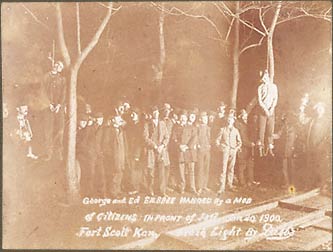
     Lynching postcards are quite different. They are only depicting violence and are even more difficult to look at because nothing tempers their wrongness. There is no feeling of brotherhood or of doing what need to be done for a greater good. In addition, photography became easier with the time, people did not need to stand still for minutes in order to take their picture. These postcards were 'live' not 'stage' as were the Civil War's photographs. Photographs were not only a mean to keep dear and good memories but started to become common. 
 
George and Ed SILSBEE HANGED by a MOB of CITIZENS IN FRONT OF JAIL. Jan. 20, 1900. Fort Scott Kan. Flash Light by Dabbs
 
      In the case of the lynching postcards, death seems represented as an entertainment, a spectacle citizens enjoyed and participated to create. It is not war casualties or self-defense. It is citizens killing other citizens because of their skin color. Even when their is no spectators in the frame, the viewer can understand that it is a warning, a message intended to be seen by onlookers. It is staged in a different way Civil War photographs were. Whereas the latter were supposed to give the image of the "good death", to reassure families back home that their father, brother or son were well taken care of; the postcards have a darker purpose: frighten free African American, celebrating White supremacy.

     The same media is used, photography, but it serves opposite purposes and ends. Civil war photographs can be perceived as intimate photographs. Even though they were display in exhibits, they somewhat private and treated with care, deference even. Lynching postcards were a mercantile object as were slaves. One can send postcards to family and friends, collect them, sell them, buy them, display them. It is as if nothing changed, as if the Civil War main purpose was not reached: freeing slaves and making African American the equal of White American.
 
     Today, seeing these postcards is disturbing, revolting, sickening, but it might not have been the case in the early 1900. Now we see them as the illustration of what should have never happened, of shame to  have let it happened, of a reminder of what should never happen again. However, then it was something normal, something to be proud of (you do not make postcards of shameful moment).
These photographs tell a different story, then and now. We can ask ourselves how today's pictures of conflicts, war, terrorisms attacks can be perceived in the next century. Are the photographs we see today in mass media any different than the ones of the Civil War and Lynching? And how so?


Lynching of Laura and L.D. Nelson


The images above, from James Allen’s collection “Without Sanctuary: Photographs and Postcards of Lynching in America,” show the infamous 1911 Oklahoma lynching of Laura Nelson and her teenage son L.D.  According to accounts from Oklahoma newspapers, L.D. shot and killed deputy George Loney while he inspected their house for meat from a reportedly stolen cow.  Laura attempted to take responsibility for the deputy’s death in order to protect her 14 year old son, yet both were arrested and simultaneously kidnapped and lynched by an angry and organized mob of white Oklahomans.  Many African Americans believed that Oklahoma, which officially became a state in 1907, represented an escape from the racism and violence of the South, yet events like this one and the widely circulated photographs to prove it put an end to this hope for a peaceful future.
The sight of a woman, with a simple dress and the countenance of youth and vitality, really sets this image apart from the rest in the collection.  The lynch mob knew of Laura Nelson’s innocence and her lie to try to save her son, yet in an extreme measure of absolute cruelty, the mob hung both her and her son in a dramatic fashion to send an even stronger message to their community and, through the postcards that came from these images, the whole world.  Their inability to show mercy to a woman who was just trying to protect her child speaks to the dehumanizing group mentality of lynch mobs of the late 19th/early 20th century United States.  Allen’s notes on the second picture discuss the prevailing idea that lynching equated the would-be punishments of the criminal justice system, as one Oklahoma Sheriff stated “while the general sentiment is adverse to the method, it is generally thought that the Negroes got what would have been due them under process of law” (http://withoutsanctuary.org/pics_33_text.html).  The all-encompassing democracy immediately following the Civil War caused many whites, especially in the South, to resort to mob and extrajudicial “justice” to African Americans accused of any number of crimes against whites.
The perspective of the photographs, particularly the one depicting the crowd on the bridge, really make the lynching seem like an public presentation.  I’m guessing that both photos were taken by photographer George Henry Farnum, owner of Oklahoma’s only photography studio in 1911, from a boat on the Canadian River.  What might very well be the entire population of Okemah, OK is gathered along the bridge, and it is unclear whether they view the lynchings with pride and dignity or horror and disgust.  Although the U.S. Postal Service banned postcards with lynchings in 1908, Farnum sold both photographs in postcard form; the first one even features “unmailable” stamped into the back.  The commoditization of these graphic events diminishes the suffering felt by the victims and reveals the widespread acceptance of a shameful, barbaric practice.

What Does Death Really Look Like?

Four photographs of the lynching of an unidentified 
African American male in a coastal Georgia swamp, 1902
The collection of lynching photographs compiled by James Allen on the “Without Sanctuary” website is not only disturbing as a set of images, but a stark and brutal reminder of an incontrovertible moral corruption in our nation’s recent history. Some images show a single body, dangling at the end of a noose, with no living bodies in sight while others are filled with onlookers eager to get a glimpse at the hanging victims. It is unclear which scene is more unsettling: the corpse left to rot silhouetted against a scenic pastoral landscape or a crowd of white men gathered around a tree to witness death much in the same way they are captivated by fly balls and home runs. Was this just a game to them? Both scenarios are graphic and horrific but it is the utter fascination that the spectators of this terrible crime seem to share is the most unnerving. Crowded around a tree where the victims have been killed, the people in the mob are not excused from their participation in this event; their presence serves to support the lynching and even in such high profile cases as some that have been documented through these postcards, no bystander is innocent. Perhaps even more upsetting, many of these images were taken by professional photographers, their names and studios etched into the negatives with dates and locations and sometimes even with personal notes about the event or the selected audience. Clearly, there was a market for these types of photographs or else they would not have been taken; the contemporaneous trend of labeling photography as a documentary medium discounts the fact that photographers were looking to make a living and sell what they could capture, even stooping so low as profiting from these lynching photographs as postcard images.

Confederate dead gathered for burial after battle,
photograph by Alexander Gardner 
            Comparing these post-war lynching photographs to the thousands that were taken by the now famous photographers of the Civil War, the fascination with death and corpses is consistent, but the surrounding context can not be avoided. The bodies laying horizontal on the battlefield are stoic in what may become their final resting place and as such, they become depersonalized; one can not discern how they were killed, what side they fought for, or even who they are. The photographers sent to capture scenes from the war were doing so in order to place the war on every front page newspaper and shock the American public by appealing to their moral hierarchy. Photography was a way to preserve memories, however skewed, for a nation that was falling apart at the seems and which have lasted through the past century. In the way the Civil War photographs are passive representations of a massive death toll, the lynching photographs are personal and intrusive attacks against the victims they portray and exploitative of their “shock value” as sellable items. Some of the identities of the hanging bodies are know as are their crimes or reason for death and they become activated in the scene both by the presence and absence of bystanders; the fact that such a photograph was even taken of the event attests to the fact that lynchings were grossly popular in the post-war period. When considering these postcards, the persecutor of the lynching may not be directly pictured but is nonetheless universally known: white men in search of an unattainable vengeance against non-white outsiders. While the photographs from the Civil War aim to portray the horrific aftermath of war for the wider public, the lynching photographs represent a perversion of the human consciousness and an unnatural fascination with images of the dead. And even more vital to this distorted narrative, both sets of photographs were taken by professionals, which ultimately poses the question: which were more important to remember, the Dead at Antietam or the “Unidentified corpse of an African American male?”    

The Spectacle of Violence: "Spectators at the lynching of Jesse Washington," 1916

James Allen’s haunting anthology of images contains many depictions of the aftermath of lynchings-- bodies hanging limply from a tree with no spectators. Images like those can be interpreted in some ways to support the narrative that lynching that happened in isolated woods, inflicted by a vigilante mob that chased down black men in the dead of night. But several images, including two postcards (9, 21) of the same scene: "Spectators at the lynching of Jesse Washington. May 16, 1916. Waco, Texas” and “Spectators at the lynching of Jesse Washington, one man raised for a better view, May 16, 1916, Waco, Texas,” force the viewer to confront the fact that lynching was, in many cases, a spectacle, a well-attended spectacle with an eager crowd, not just an angry mob. According to the description, fifteen thousand people came to watch and cheer the death of Jesse Washington, a mentally handicapped young man of 17 who had been swiftly convicted after confessing to the murder of a white woman.  The description provided by James Allen of the scene illustrates the eagerness of the crowd to absorb every detail: "Fifteen thousand men, women, and children packed the square. They climbed up poles and onto the tops of cars, hung from windows, and sat on each other's shoulders. Children were lifted by their parents into the air." Within this image is a particularly repulsive element where a man in the foreground is being lifted for better view of the unfolding scene, which is a gruesome series of mutilations and burnings. The photographer has elected to capture the spirit of the crowd with wide-angle shots as opposed to focusing on the horror unfolding in the center.

While it can be argued that public hangings have long been spectacles, there is something insidious in the way that that post-Reconstruction spectacle of violence has largely been written out of American history. From my experience in history classes, the common narrative taught about lynchings is that the KKK came in the night and terrorized black communities (with implicit and often explicit support from local law enforcement), but the violence against black people was not relished by crowded squares with men, women and children looking on. Lynchings and violence are painted as an unfortunate, radical, peripheral element of the specter of Jim Crowe racism that hung over the South-- but there is a distance put between the mobs of angered men who carry out such acts and the greater community. Photographs of large, enthusiastic crowds like those watching the lynching of Jesse Washington, Ruben Stacy, Thomas Shipp and Abram Smith (1930) highlight the naturalized state of terror.
Many images (and accompanying descriptions) in the Without Sanctuary collection offer a counter to the prevalent narrative of black men assaulting white women, as discussed notably in relation to “The lynching of Virgil Jones, Robert Jones, Thomas Jones and Joseph Riley. Black onlookers, July 31, 1908. Russellville, Logan County, Kentucky” image, which falsely attributes the victim’s crimes as rape, when in fact Allen writes they were accused of criticizing the white dominated legal system. This false attribution perpetuated the narrative that blacks were “sexually uncontrollable” and that violence necessary for control. The centrality of rape and violence against white women in the justification narrative of lynchings is explored deeply in Cardyn’s “Sexualized Racism/ Gendered Violence: Enraging the Body Politic in the Reconstructions South.” While the individual stories of victims and greater narratives (falsely maintained) that helped fuel violence require attention, the analysis of postcards of the lynching of Jesse Washington has focused largely on reemphasizing the spectator’s involvement and encouragement of violence. 

 Spectators at the lynching of Jesse Washington. May 16, 1916. Waco, Texas
Spectators at the lynching of Jesse Washington, one man raised for a better view, May 16, 1916, Waco, Texas.

Monday, April 6, 2015

Our presenters last week reflected on the general absence of violence from photographs of the Civil War, with the important exception of Brady and O'Sullivan's photographs of corpses of soldiers killed in battle at Antietam and Gettysburg.  These debuted to the horror of American gallery-goers and were neglected in the aftermath of war.  [See links in sidebar.]

In spite of these silences, we know violence is a central theme in US history: in the expulsion of indigenous people from their lands, the institution of slavery, the conquest of Mexican lands, the experience of civil war.  Sven Beckert, writing a history of capitalism, has gone so far as to rebrand "mercantile capitalism" as "war capitalism," intent on emphasizing the indispensability of violence to the development of economies based on commodity production for world markets.

In this week of the course alone, we're obliged to acknowledge violence as one of the primary reasons for the failure of Reconstruction: the Ku Klux Klan's campaign of terror against black Americans subdued the nation's first attempts at interracial democracy in the South. (For descriptions of the KKK's tactics, see Lisa Cardyn's "Sexualized Racism/Gendered Violence: Outraging the Body Politic in the Reconstruction South")  Lynchings remained common in the Southern states through the 1930s.  (See (1) Brundage, Lynching in the New South, (2) the postcards of lynchings collected by James Allen [note accompanying essays by historians and civil rights activists], and (3) the NYT feature on the recent report of the Equal Justice Initiative in Montgomery, Alabama.)  [All of the aforementioned resources are linked in the sidebar.]

So we have incontrovertible evidence of a history of widespread violence and terrorism in the United States: yet perhaps not one with which many people are familiar. This simultaneous documentation and eschewal raises the question: how do we make sense of the presence or absence of records of violence in American histories?  To what extent does the United States have a usable history of violence? Of terrorism?

Option 1 is to reflect on these questions, making reference to the aforementioned sources and to American history more broadly, including contemporary conflicts and exercises of force/violence.
Option 2 is to compare the lynching postcards collected by James Allen to the photographs of the Civil War discussed in class or to accounts of death provided in Faust's Republic of Suffering.
Option 3 is to analyze one of the postcard images [please include the image in your post], taking into account the setting, role of the photographer, spectators, killers, and victim.  Be aware that these are very upsetting images, and that the exercise of describing them will also be disturbing.

Please label your posts with any relevant keywords or important motifs to make the cloud navigation in the sidebar meaningful.