Showing posts with label photograph. Show all posts

Tuesday, April 14, 2015

The Lynching of W.C. Williams

This postcard depicts the lynching of W.C. Williams in Ruston Louisiana, on October 15, 1938. Of all the photographs I viewed, this one struck me most, first because the event it captures it took place later than any other in Allen’s collection. Our resource purports that Williams was most likely castrated before being hanged based on the blood dripping down his legs. A quick google search makes the photograph even more disturbing.
According to Northeastern University Law Schools’ database, Williams was a 19 year old African American who was not sound of mind. The lynching of Williams was orchestrated by three white male teenagers, in response to the recent killing of R.M. Blair, a white man, and the beating of his female companion. A lynch mob which grew to about 3,000 people disregarded the sheriff’s pleas for order, and Williams was tortured, shot, hanged, and ultimately burned to death. The image in the photograph is particularly graphic, as the angle of the shot reveals the torture Williams underwent prior to his death.
            The setting of the photograph seems to be a rural area, however, to draw such a crowd, the scene of the lynching must have been publicly accessible. The angle from which the photographer takes the photo is significant because it captures the gathered crowd, who all appear to be there for the spectacle. The fact that in 1938, areas like Ruston Louisiana could attract over 3,000 people to watch a gruesome lynching is astounding. It reveals the extensive racial tensions and white supremacy which pervaded in areas of the Deep South then, and continues in certain areas today. It really is quite horrifying to see both indifference and general revelry on the faces of those in the crowd. Even more upsetting is that the lynching was facilitated by three white teenagers who simply happened upon Williams while driving down a rural road. I do not know whether the three teenagers were the ones who ultimately killed Williams, but they initiated the lynching. This reveals social structures, especially in the South, in which being young, white, and male gives one an inordinate amount of power, and essentially shields one from the consequences of heinous actions.
            Williams was the complete opposite of the young males who initially captured him. He did not have the privilege of being white, or even sound of mind. This makes his lynching all the more disturbing. While one might think that he might be treated better as a result of his mental disability, I would venture to say that his disability and the color of his skinned combined perfectly in the minds of the gathered crown, and painted the picture of a deranged, deviant killer. And thus, he was castrated, like an animal that is not fit to breed. The dehumanization of Williams is beyond comprehension for me.
            While the photograph in and of itself is extremely disturbing, the context surrounding the events makes it even more so. What is most unsettling to me though, is that a culture existed in the United States even a century ago which was desensitized to not only the practice of lynching, but also to depictions of it in ways which painted spectators as highly amused, killers vigilante heroes, and victims as animals.

Additional info,


Monday, April 13, 2015

The Lynching of Will James

Found on the website of the James Allen collection of Lynching Postcards is a set of seven images devoted to the lynching of Will James. The photographs tell an important story of how this lynching was glorified and established as an attraction for the town of Cairo Illinois. Two photos in particular are especially compelling in their portrayal of Commercial Avenue in Cairo. 


First, image 43 (above), shows what is probably a drawing/painting of Commercial Avenue. The image shows what appears to be a normal main avenue in an average sized city in early 1900s America. In image 44 (right), we see a far different portrayal of Commercial Avenue.

Image 44 shows us Commercial Avenue filled with citizens of Cairo at night time during the lynching. The street is lit up for the lynching as a street would be lit today if a concert, festival, or parade took place on it. The street is packed with people standing shoulder to shoulder as far as the camera can see. The photographer found a perch far behind and high above the crowd in order to take a picture. The body of Will James cannot even be seen. 


What I find so compelling about these two images is that the lynching, the death of a man, was such an attractive event for so many people that the town of Cairo spent the time and money to establish the event as one for thousands of spectators. Perhaps town officials saw it as a way for citizens to come together. Perhaps they saw the event as a way to advertise the consequences of certain actions. All that I know, however, is that the lynching was enough of a big deal for the town of Cairo to come together with enthusiasm to watch a man die. 

Commodification, Abuse, and Lynching of An Unidentified Black Male


African American male standing on buggy, facing camera, stripped, deep lacerations and wounds, his handcuffed hands placed to cover his genitals. lynch mob. Circa 1900, location unknown. 

African American man standing on a buggy, back to the camera, feet shackled, stripped, deep lacerations and wounds.

Onlookers, one with a bloodstained shirt. Circa 1900, locat
ion unknown.  

Lynching of African American male, victim hanging in a tree, stripped, lower body wrapped in coarse blanket. Lynch mob. Circa 1900, location unknown.
This series of images from James Allen's "Without Sanctuary: Photographs and Postcards of Lynching in America" most graphically displays the abuses people of color incurred at the hands of the white majority and illustrates the role violence played in the Reconstruction period. In the form of a time series, starting with the unidentified man facing the camera to the his eventual lynching, one can observe the exploitation of this man's body and the abuses he suffered leading to his eventual lynching, which is seen in the third image to be a social spectacle and cause for gathering. 

Although post-emancipation, the lasting effects of institutional slavery are apparent in the first two images. Recalling the images we saw in class and discussions revolving around the 'chattel principle,' this unidentified man being displayed harkens back to the slave auction set-up in which slaves were displayed on a stage of sale and reinforces the importance of the physical body of the slave as a 'product'--in this case the body of the man preparing for his impending death. The man has taken an obvious beating and the lashings can be attributed to the white man "in the righthand corner, wearing a soft-brimmed hat, edging into the camera's view" holding a whip (Background Info). By displaying this man as naked, the white men have stripped him of all agency and have left him vulnerable to the onlookers attending his lynching. It is not explicitly stated, but this man is most-likely facing some accusation resulting in his eventual lynching, which has been deemed important enough to draw a major crowd of all white males (based on the limited visibility of the people in the images). It is imperative to acknowledge the lack of information regarding the identity of this man, the location of this event, and of what he is being accused. At this time, public records are limited and not particularly informative. Labeling this man 'unidentified' and noting the location as 'unknown' further dehumanizes the entire event and could, in a way, justify the practice of lynching and its public acceptance of the white crowd. By not providing a name, the crowd distances themselves only focusing on what he is accused of. (Note: the lack of information and record keeping could have been avoided. However, literate whites were the ones controlling the record keeping and therefore controlled published records selectively). In the case of this series of images, the photographer captures the entire body of the man, which further emphasizes the importance of the 'body.' Although not being sold, his body is commodified as the object of persecution that people have to come to see killed. The photographer captures this image up to the culmination of the event at the lynching. By hanging the man on a raised platform from a tree, he is made more public broadening the reach for audience capacity and further expanding the event's influence. Speaking of a mass audience and tying this event to traditional capitalism, by making these images available in the form of postcards, people could visually distribute a first-hand account of the incident to a greater number of people spanning traditional geographic boundaries. The traditional racist, southern stereotype could expand its influence beyond formal boundaries. 

From the 16th-century to the Reconstruction period, European and American imperialism/exceptionalism has systematically stripped Native people and minorities of land and fundamental rights. In this time, Columbus disenfranchised the natives, American/European capitalist elites forced the migration of African slaves promoting their end-goals, U.S. government forced the relocation of Native Americans, and the rise of white supremacy in the form of terrorist groups (KKK) continually reinforced a social hierarchy of white dominance. The acceptance of not only this series of images, but all of the images provided in James Allen's "Without Sanctuary: Photographs and Postcards of Lynching in America" displays the race inequity that has permeated throughout the course of American history. 

Lynching of Lige Daniels

This postcard shows the lynching of Lige Daniels in Texas in 1920 with many onlookers. It is a disturbing image and the additional information about what preceded this lynching adds immensely to that. Allen's site tells us that there were specific orders to protect Daniels from mob violence given to a Captain, but that he ignored those orders and that one thousand men entered the prison where Daniels was being held and lynched him after wrecking the cell. This information adds a layer of violence that we would not understand just by viewing the image. We do see the faces of many onlookers, but knowing that they probably took part in the lynching itself and in rounding Daniels up makes it somehow worse. Some of the people in the front of the picture are young boys, one of whom is smiling. This is a disgusting display of young people being indoctrinated and made to enjoy such horrific act.

Both the image itself (and the mentality and story behind the lynching) reveal the dehumanization of blacks that occurred in the South. All of the whites are facing the camera, but Daniels' body is left turned to the side, removing his humanity. The onlookers also deny him his humanity by turning away from him. However, looking at the image today, there seems to be an almost religious aspect to it with the way Daniels appears to be ascending into the light. Certainly, it was not intended by the photographer or killers, but is an interesting source of irony when the image is viewed in retrospect.

The back of the postcard gives us more information about what went on in this image. Daniels was 16 years old, which isn't much older than some of the children who participated in the lynching. It also alleges that he killed someone, a crime which he never got to defend himself for because of the violence perpetuated against black men (and boys) who were even suspected of a crime. Rule of law went out the window for them the minute a white mob decided that their version of "justice" should prevail. The rest of the message on the postcard is very matter-of-fact: "Give this to Bud. From Aunt Myrtle." We don't know, but the language used here makes the lynching seem like a very routine violent action. It also indicates that these lynchings were events to be shared. Clearly, they were social events, looking at all of the onlookers, but they were also things that people wanted to share with friends and family who weren't there. This form of documentation of these violent killings is particularly disturbing because it means that people were taking enough pleasure in killing black men after the fact, and they thought that others would too, to photograph and distribute these killings. These postcards tell us just how dehumanized and hated black men were in the South, even so many decades after the Civil War.

Lynching postcards / Civil War photographs : a different story telling


     Gardner's and Brady's photographs of the Civil War are mostly about keeping memories, having something left of those soldiers. Most of the photographs staged union soldiers in front of their tent or cabin, playing cards, waiting. Some of them would be of abandoned houses, camps, drills, work on the field (building bridges, telegraphs...); and a few would be of death. However, as it was pointed out, even those photographs of dead bodies were staged: corpse were moved, and there would not have any photograph of the actual violence of the war: battles, soldiers firing...

Plate 27: What do I do, John Henry?
Plate 36: Harvest of death


Plate 27, tends to give a romanticized idea of what the life  in camp was. The soldiers are well dress and seem to have a "good life" as well as "enjoying" themselves and there brotherhood. Whereas plate 36, gives a feeling of helplessness. 

     Lynching postcards are quite different. They are only depicting violence and are even more difficult to look at because nothing tempers their wrongness. There is no feeling of brotherhood or of doing what need to be done for a greater good. In addition, photography became easier with the time, people did not need to stand still for minutes in order to take their picture. These postcards were 'live' not 'stage' as were the Civil War's photographs. Photographs were not only a mean to keep dear and good memories but started to become common. 
 
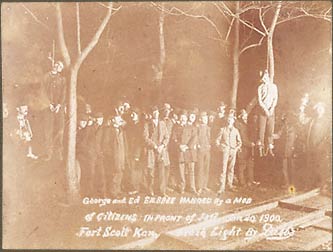
George and Ed SILSBEE HANGED by a MOB of CITIZENS IN FRONT OF JAIL. Jan. 20, 1900. Fort Scott Kan. Flash Light by Dabbs
 
      In the case of the lynching postcards, death seems represented as an entertainment, a spectacle citizens enjoyed and participated to create. It is not war casualties or self-defense. It is citizens killing other citizens because of their skin color. Even when their is no spectators in the frame, the viewer can understand that it is a warning, a message intended to be seen by onlookers. It is staged in a different way Civil War photographs were. Whereas the latter were supposed to give the image of the "good death", to reassure families back home that their father, brother or son were well taken care of; the postcards have a darker purpose: frighten free African American, celebrating White supremacy.

     The same media is used, photography, but it serves opposite purposes and ends. Civil war photographs can be perceived as intimate photographs. Even though they were display in exhibits, they somewhat private and treated with care, deference even. Lynching postcards were a mercantile object as were slaves. One can send postcards to family and friends, collect them, sell them, buy them, display them. It is as if nothing changed, as if the Civil War main purpose was not reached: freeing slaves and making African American the equal of White American.
 
     Today, seeing these postcards is disturbing, revolting, sickening, but it might not have been the case in the early 1900. Now we see them as the illustration of what should have never happened, of shame to  have let it happened, of a reminder of what should never happen again. However, then it was something normal, something to be proud of (you do not make postcards of shameful moment).
These photographs tell a different story, then and now. We can ask ourselves how today's pictures of conflicts, war, terrorisms attacks can be perceived in the next century. Are the photographs we see today in mass media any different than the ones of the Civil War and Lynching? And how so?


Lynching of Laura and L.D. Nelson


The images above, from James Allen’s collection “Without Sanctuary: Photographs and Postcards of Lynching in America,” show the infamous 1911 Oklahoma lynching of Laura Nelson and her teenage son L.D.  According to accounts from Oklahoma newspapers, L.D. shot and killed deputy George Loney while he inspected their house for meat from a reportedly stolen cow.  Laura attempted to take responsibility for the deputy’s death in order to protect her 14 year old son, yet both were arrested and simultaneously kidnapped and lynched by an angry and organized mob of white Oklahomans.  Many African Americans believed that Oklahoma, which officially became a state in 1907, represented an escape from the racism and violence of the South, yet events like this one and the widely circulated photographs to prove it put an end to this hope for a peaceful future.
The sight of a woman, with a simple dress and the countenance of youth and vitality, really sets this image apart from the rest in the collection.  The lynch mob knew of Laura Nelson’s innocence and her lie to try to save her son, yet in an extreme measure of absolute cruelty, the mob hung both her and her son in a dramatic fashion to send an even stronger message to their community and, through the postcards that came from these images, the whole world.  Their inability to show mercy to a woman who was just trying to protect her child speaks to the dehumanizing group mentality of lynch mobs of the late 19th/early 20th century United States.  Allen’s notes on the second picture discuss the prevailing idea that lynching equated the would-be punishments of the criminal justice system, as one Oklahoma Sheriff stated “while the general sentiment is adverse to the method, it is generally thought that the Negroes got what would have been due them under process of law” (http://withoutsanctuary.org/pics_33_text.html).  The all-encompassing democracy immediately following the Civil War caused many whites, especially in the South, to resort to mob and extrajudicial “justice” to African Americans accused of any number of crimes against whites.
The perspective of the photographs, particularly the one depicting the crowd on the bridge, really make the lynching seem like an public presentation.  I’m guessing that both photos were taken by photographer George Henry Farnum, owner of Oklahoma’s only photography studio in 1911, from a boat on the Canadian River.  What might very well be the entire population of Okemah, OK is gathered along the bridge, and it is unclear whether they view the lynchings with pride and dignity or horror and disgust.  Although the U.S. Postal Service banned postcards with lynchings in 1908, Farnum sold both photographs in postcard form; the first one even features “unmailable” stamped into the back.  The commoditization of these graphic events diminishes the suffering felt by the victims and reveals the widespread acceptance of a shameful, barbaric practice.

Postcard of Lynching in Duluth, Minnesota


This postcard, displayed on James Allen’s website, “Without Sanctuary: Photographs and Postcards of Lynching in America,” reads “THREE NEGROES LYNCHED AT DULUTH, MINN FOR RAPE. OCT, 1919.” In fact, this lynching took place in Duluth Minnesota the following year, in 1920. The three men pictured, Elias Clayton, Elmer Jackson, and Isaac McGhie, were killed in response to rape allegations made by the father of nineteen year old Irene Tusken. Her father told the Duluth Police Chief that six Black men, who were working for a circus that she had attended, had raped her at gunpoint.
After six Black men were arrested for the rape, a mob of between 1,000 and 10,000 white people crowded around the jail, eventually breaking in and capturing the Black men inside. They proceeded to hold a “mock trial,” and after finding Clayton, Jackson, and McGhie guilty, the mob lynched the three men on a nearby lamp pole. It was there, at that lamp pole, that this photograph was taken.
Following the event, The Chicago Evening Post exclaimed, “This is a crime of a Northen state, as black and ugly as any that has brought the South in disrepute.” Although I have been taught some about the history of “Lynch Law” in the United States, I have always learned about lynching as a mostly Southern phenemonen, and was surprised to learn that this horiffic event took place in Minnesota.
Of course, the murder of these three men in Duluth is part of an extensive history of lynching throughout the United States, and is one example of the many lynchings of Black men who were accused of raping white women. In this instance, “little evidence would be found to corroborate” the rape accusations. Lisa Cardyn, in “Sexualized Racism/Gendered Violence: Outraging the Body Politic in the Reconstruction South,” explains, “While these crimes, too, surely occurred throughout the period, charges of this nature were also routinely fabricated and manipulated by klans- men bent on portraying themselves as defenders of vulnerable white womanhood” (765).
Violence against Black men was regularly perpetrated in the name of protecting White women; a fictitious opposition was created between the safety of White women and the freedom of Black men, leading to murders such as those depicted in this postcard. The crowd shown is made up entirely of White men, leading me to question what role White women played in lynchings. Would they participate in the actual practice of lynching, or were they merely the reason that white men used to perpetuate the lynchings?
It is clear that many of the men in this scene are posing and are aware that the photographer is taking the photo. Some men appear to be standing on their toes, trying to get into the photograph as best they can. Others, disturbingly, are smiling at the camera, and even most of those who are not smiling do not have particularly serious expressions on their faces. They seem excited about the photograph being taken, as though they want a lasting souvenir of this experience. One smiling man, on the right hand side, is leaning into another man, who has his arm on him, suggesting closeness between them, as though lynching was a bonding experience for the White men involved.
Elias Clayton, Elmer Jackson, and Isaac McGhie are placed in the center of the photograph, with the men crowded around them, though none of the men are looking at them or acknowledging their presense in any way. These murdered men stand out; they look out of place in this photo, which, disturbingly, might otherwise look like a friendly gathering of men. The fact that their chests are exposed also stands out, for all of the other men pictured are fully clothed. The fact that Clayton, Jackson, and McGhie’s shirts were removed or pulled down to expose their chests is significant, for it suggests that the murderers wanted to make a public display of their naked bodies. Why might this be? Does the act of removing their clothes further dehumanize them? Does it connect to the fact that they are being “punished” for an alleged sexual crime?

Additional Sources:
"Duluth Lynchings Online Resource: Lynchings." Duluth Lynchings Online Resource: Lynchings. N.p., n.d. Web. 09 Apr. 2015. <http://collections.mnhs.org/duluthlynchings/html/lynchings.htm>.