Gardner's and Brady's photographs of the Civil War are mostly about keeping memories, having something left of those soldiers. Most of the photographs staged union soldiers in front of their tent or cabin, playing cards, waiting. Some of them would be of abandoned houses, camps, drills, work on the field (building bridges, telegraphs...); and a few would be of death. However, as it was pointed out, even those photographs of dead bodies were staged: corpse were moved, and there would not have any photograph of the actual violence of the war: battles, soldiers firing...
 |
| Plate 27: What do I do, John Henry? |
 |
| Plate 36: Harvest of death |
Plate 27, tends to give a romanticized idea of what the life in camp was. The soldiers are well dress and seem to have a "good life" as well as "enjoying" themselves and there brotherhood. Whereas plate 36, gives a feeling of helplessness.
Lynching postcards are quite different. They are only depicting violence and are even more difficult to look at because nothing tempers their wrongness. There is no feeling of brotherhood or of doing what need to be done for a greater good. In addition, photography became easier with the time, people did not need to stand still for minutes in order to take their picture. These postcards were 'live' not 'stage' as were the Civil War's photographs. Photographs were not only a mean to keep dear and good memories but started to become common.
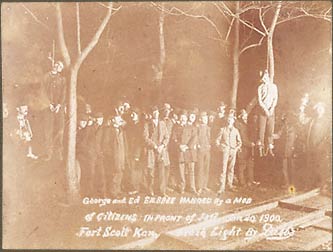 |
| George and Ed SILSBEE HANGED by a MOB of CITIZENS IN FRONT OF JAIL. Jan. 20, 1900. Fort Scott Kan. Flash Light by Dabbs |
In the case of the lynching postcards, death seems represented as an
entertainment, a spectacle citizens enjoyed and participated to create.
It is not war casualties or self-defense. It is citizens killing other
citizens because of their skin color. Even when their is no spectators in the frame, the viewer can understand that it is a warning, a message intended to be seen by onlookers. It is staged in a different way Civil War photographs were. Whereas the latter were supposed to give the image of the "good death", to reassure families back home that their father, brother or son were well taken care of; the postcards have a darker purpose: frighten free African American, celebrating White supremacy.
The same media is used, photography, but it serves opposite purposes and ends. Civil war photographs can be perceived as intimate photographs. Even though they were display in exhibits, they somewhat private and treated with care, deference even. Lynching postcards were a mercantile object as were slaves. One can send postcards to family and friends, collect them, sell them, buy them, display them. It is as if nothing changed, as if the Civil War main purpose was not reached: freeing slaves and making African American the equal of White American.
Today, seeing these postcards is disturbing, revolting, sickening, but it might not have been the case in the early 1900. Now we see them as the illustration of what should have never happened, of shame to have let it happened, of a reminder of what should never happen again. However, then it was something normal, something to be proud of (you do not make postcards of shameful moment).
These photographs tell a different story, then and now. We can ask ourselves how today's pictures of conflicts, war, terrorisms attacks can be perceived in the next century. Are the photographs we see today in mass media any different than the ones of the Civil War and Lynching? And how so?

No comments:
Post a Comment