Showing posts with label gendered violence. Show all posts

Tuesday, April 14, 2015

The Lynching of W.C. Williams

This postcard depicts the lynching of W.C. Williams in Ruston Louisiana, on October 15, 1938. Of all the photographs I viewed, this one struck me most, first because the event it captures it took place later than any other in Allen’s collection. Our resource purports that Williams was most likely castrated before being hanged based on the blood dripping down his legs. A quick google search makes the photograph even more disturbing.
According to Northeastern University Law Schools’ database, Williams was a 19 year old African American who was not sound of mind. The lynching of Williams was orchestrated by three white male teenagers, in response to the recent killing of R.M. Blair, a white man, and the beating of his female companion. A lynch mob which grew to about 3,000 people disregarded the sheriff’s pleas for order, and Williams was tortured, shot, hanged, and ultimately burned to death. The image in the photograph is particularly graphic, as the angle of the shot reveals the torture Williams underwent prior to his death.
            The setting of the photograph seems to be a rural area, however, to draw such a crowd, the scene of the lynching must have been publicly accessible. The angle from which the photographer takes the photo is significant because it captures the gathered crowd, who all appear to be there for the spectacle. The fact that in 1938, areas like Ruston Louisiana could attract over 3,000 people to watch a gruesome lynching is astounding. It reveals the extensive racial tensions and white supremacy which pervaded in areas of the Deep South then, and continues in certain areas today. It really is quite horrifying to see both indifference and general revelry on the faces of those in the crowd. Even more upsetting is that the lynching was facilitated by three white teenagers who simply happened upon Williams while driving down a rural road. I do not know whether the three teenagers were the ones who ultimately killed Williams, but they initiated the lynching. This reveals social structures, especially in the South, in which being young, white, and male gives one an inordinate amount of power, and essentially shields one from the consequences of heinous actions.
            Williams was the complete opposite of the young males who initially captured him. He did not have the privilege of being white, or even sound of mind. This makes his lynching all the more disturbing. While one might think that he might be treated better as a result of his mental disability, I would venture to say that his disability and the color of his skinned combined perfectly in the minds of the gathered crown, and painted the picture of a deranged, deviant killer. And thus, he was castrated, like an animal that is not fit to breed. The dehumanization of Williams is beyond comprehension for me.
            While the photograph in and of itself is extremely disturbing, the context surrounding the events makes it even more so. What is most unsettling to me though, is that a culture existed in the United States even a century ago which was desensitized to not only the practice of lynching, but also to depictions of it in ways which painted spectators as highly amused, killers vigilante heroes, and victims as animals.

Additional info,


Monday, April 13, 2015

Lynching postcards / Civil War photographs : a different story telling


     Gardner's and Brady's photographs of the Civil War are mostly about keeping memories, having something left of those soldiers. Most of the photographs staged union soldiers in front of their tent or cabin, playing cards, waiting. Some of them would be of abandoned houses, camps, drills, work on the field (building bridges, telegraphs...); and a few would be of death. However, as it was pointed out, even those photographs of dead bodies were staged: corpse were moved, and there would not have any photograph of the actual violence of the war: battles, soldiers firing...

Plate 27: What do I do, John Henry?
Plate 36: Harvest of death


Plate 27, tends to give a romanticized idea of what the life  in camp was. The soldiers are well dress and seem to have a "good life" as well as "enjoying" themselves and there brotherhood. Whereas plate 36, gives a feeling of helplessness. 

     Lynching postcards are quite different. They are only depicting violence and are even more difficult to look at because nothing tempers their wrongness. There is no feeling of brotherhood or of doing what need to be done for a greater good. In addition, photography became easier with the time, people did not need to stand still for minutes in order to take their picture. These postcards were 'live' not 'stage' as were the Civil War's photographs. Photographs were not only a mean to keep dear and good memories but started to become common. 
 
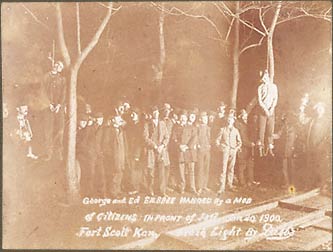
George and Ed SILSBEE HANGED by a MOB of CITIZENS IN FRONT OF JAIL. Jan. 20, 1900. Fort Scott Kan. Flash Light by Dabbs
 
      In the case of the lynching postcards, death seems represented as an entertainment, a spectacle citizens enjoyed and participated to create. It is not war casualties or self-defense. It is citizens killing other citizens because of their skin color. Even when their is no spectators in the frame, the viewer can understand that it is a warning, a message intended to be seen by onlookers. It is staged in a different way Civil War photographs were. Whereas the latter were supposed to give the image of the "good death", to reassure families back home that their father, brother or son were well taken care of; the postcards have a darker purpose: frighten free African American, celebrating White supremacy.

     The same media is used, photography, but it serves opposite purposes and ends. Civil war photographs can be perceived as intimate photographs. Even though they were display in exhibits, they somewhat private and treated with care, deference even. Lynching postcards were a mercantile object as were slaves. One can send postcards to family and friends, collect them, sell them, buy them, display them. It is as if nothing changed, as if the Civil War main purpose was not reached: freeing slaves and making African American the equal of White American.
 
     Today, seeing these postcards is disturbing, revolting, sickening, but it might not have been the case in the early 1900. Now we see them as the illustration of what should have never happened, of shame to  have let it happened, of a reminder of what should never happen again. However, then it was something normal, something to be proud of (you do not make postcards of shameful moment).
These photographs tell a different story, then and now. We can ask ourselves how today's pictures of conflicts, war, terrorisms attacks can be perceived in the next century. Are the photographs we see today in mass media any different than the ones of the Civil War and Lynching? And how so?


Lynching of Laura and L.D. Nelson


The images above, from James Allen’s collection “Without Sanctuary: Photographs and Postcards of Lynching in America,” show the infamous 1911 Oklahoma lynching of Laura Nelson and her teenage son L.D.  According to accounts from Oklahoma newspapers, L.D. shot and killed deputy George Loney while he inspected their house for meat from a reportedly stolen cow.  Laura attempted to take responsibility for the deputy’s death in order to protect her 14 year old son, yet both were arrested and simultaneously kidnapped and lynched by an angry and organized mob of white Oklahomans.  Many African Americans believed that Oklahoma, which officially became a state in 1907, represented an escape from the racism and violence of the South, yet events like this one and the widely circulated photographs to prove it put an end to this hope for a peaceful future.
The sight of a woman, with a simple dress and the countenance of youth and vitality, really sets this image apart from the rest in the collection.  The lynch mob knew of Laura Nelson’s innocence and her lie to try to save her son, yet in an extreme measure of absolute cruelty, the mob hung both her and her son in a dramatic fashion to send an even stronger message to their community and, through the postcards that came from these images, the whole world.  Their inability to show mercy to a woman who was just trying to protect her child speaks to the dehumanizing group mentality of lynch mobs of the late 19th/early 20th century United States.  Allen’s notes on the second picture discuss the prevailing idea that lynching equated the would-be punishments of the criminal justice system, as one Oklahoma Sheriff stated “while the general sentiment is adverse to the method, it is generally thought that the Negroes got what would have been due them under process of law” (http://withoutsanctuary.org/pics_33_text.html).  The all-encompassing democracy immediately following the Civil War caused many whites, especially in the South, to resort to mob and extrajudicial “justice” to African Americans accused of any number of crimes against whites.
The perspective of the photographs, particularly the one depicting the crowd on the bridge, really make the lynching seem like an public presentation.  I’m guessing that both photos were taken by photographer George Henry Farnum, owner of Oklahoma’s only photography studio in 1911, from a boat on the Canadian River.  What might very well be the entire population of Okemah, OK is gathered along the bridge, and it is unclear whether they view the lynchings with pride and dignity or horror and disgust.  Although the U.S. Postal Service banned postcards with lynchings in 1908, Farnum sold both photographs in postcard form; the first one even features “unmailable” stamped into the back.  The commoditization of these graphic events diminishes the suffering felt by the victims and reveals the widespread acceptance of a shameful, barbaric practice.

Monday, April 6, 2015

Our presenters last week reflected on the general absence of violence from photographs of the Civil War, with the important exception of Brady and O'Sullivan's photographs of corpses of soldiers killed in battle at Antietam and Gettysburg.  These debuted to the horror of American gallery-goers and were neglected in the aftermath of war.  [See links in sidebar.]

In spite of these silences, we know violence is a central theme in US history: in the expulsion of indigenous people from their lands, the institution of slavery, the conquest of Mexican lands, the experience of civil war.  Sven Beckert, writing a history of capitalism, has gone so far as to rebrand "mercantile capitalism" as "war capitalism," intent on emphasizing the indispensability of violence to the development of economies based on commodity production for world markets.

In this week of the course alone, we're obliged to acknowledge violence as one of the primary reasons for the failure of Reconstruction: the Ku Klux Klan's campaign of terror against black Americans subdued the nation's first attempts at interracial democracy in the South. (For descriptions of the KKK's tactics, see Lisa Cardyn's "Sexualized Racism/Gendered Violence: Outraging the Body Politic in the Reconstruction South")  Lynchings remained common in the Southern states through the 1930s.  (See (1) Brundage, Lynching in the New South, (2) the postcards of lynchings collected by James Allen [note accompanying essays by historians and civil rights activists], and (3) the NYT feature on the recent report of the Equal Justice Initiative in Montgomery, Alabama.)  [All of the aforementioned resources are linked in the sidebar.]

So we have incontrovertible evidence of a history of widespread violence and terrorism in the United States: yet perhaps not one with which many people are familiar. This simultaneous documentation and eschewal raises the question: how do we make sense of the presence or absence of records of violence in American histories?  To what extent does the United States have a usable history of violence? Of terrorism?

Option 1 is to reflect on these questions, making reference to the aforementioned sources and to American history more broadly, including contemporary conflicts and exercises of force/violence.
Option 2 is to compare the lynching postcards collected by James Allen to the photographs of the Civil War discussed in class or to accounts of death provided in Faust's Republic of Suffering.
Option 3 is to analyze one of the postcard images [please include the image in your post], taking into account the setting, role of the photographer, spectators, killers, and victim.  Be aware that these are very upsetting images, and that the exercise of describing them will also be disturbing.

Please label your posts with any relevant keywords or important motifs to make the cloud navigation in the sidebar meaningful.